October 26, 2023
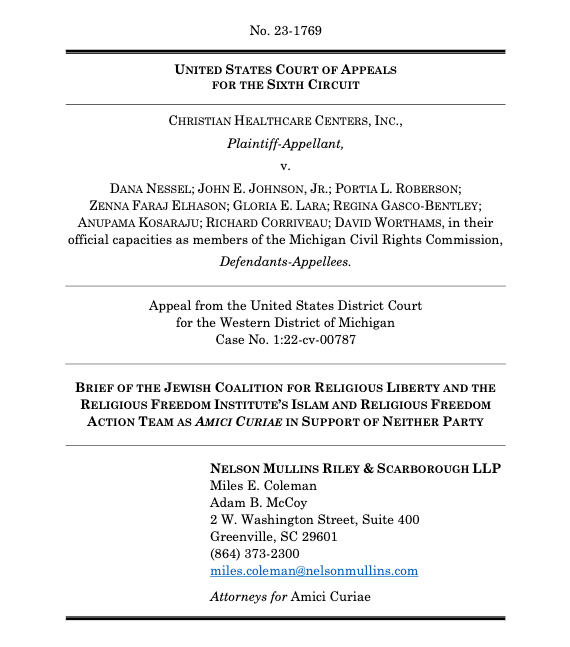
Summary of facts: Michigan’s civil rights law, which state courts recently reinterpreted to include “sexual orientation and gender identity,” now requires religious organizations like Christian Healthcare Centers (CHC) to hire people who do not share their faith, to prescribe cross-sex hormones to facilitate efforts to alter a patient’s biological sex, and to use pronouns that do not accord with a person’s biological sex. CHC sued in federal district court, alleging that these requirements violate its First Amendment religious rights and seeking a preliminary injunction to prevent enforcement of state law. The court denied the motion, and CHC appealed to the U.S. Court of Appeals for the Sixth Circuit.
RFI’s position: The First Amendment to the U.S. Constitution prohibits states from interfering in the hiring practices of religious institutions, including organizations like CHC. This principle is reflected in the policies of both federal and state governments. The state’s restriction of religious organizations’ ability to make religiously informed personnel decisions would have an especially harmful effect on minority religious groups such as Jews and Muslims. The court should invalidate this aspect of Michigan law.
Read the amicus brief here.
THE RFI BLOG

Jul. 26, 2024
Myths of Religious Nationalism in America and Abroad

Jul. 26, 2024
France’s Olympic Hijab Ban Violates International Law And Exacerbates Tensions
Jul. 25, 2024
RFI Briefs USCIRF on Lessons from 25 Years of U.S. Designating Religious Freedom Violators

Jul. 23, 2024
Thought Police: Protecting the People from Prayer

Jul. 22, 2024
A Religious “Delaware”: Establishing a State Haven for Religious Corporations
CORNERSTONE FORUM

Jun. 26, 2024
Challenges to Religious Freedom in Iraq and the Critical Need for Action

May. 05, 2023
Public Bioethics & the Failure of Expressive Individualism

Apr. 28, 2023
Religious Liberty in American Higher Education

Mar. 03, 2023
Scotland’s Kate Forbes and the March of Secularism

Dec. 09, 2022