April 26, 2024
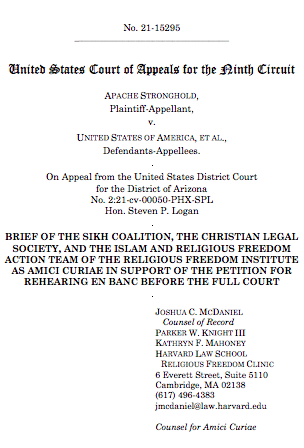
Summary of facts: In 2014, Congress ordered the transfer of an Apache worship site in Arizona to a multinational mining corporation seeking to turn the land into a copper mine. The Apache sued, arguing that the federal government’s transfer of the land was a substantial burden on their religious exercise under the Religious Freedom Restoration Act (RFRA). A 3-judge panel of the US Court of Appeals for the Ninth Circuit ruled against the Apache, holding that the destruction of a sacred worship site does not constitute a “substantial burden” under its interpretation of RFRA. The Ninth Circuit then agreed to rehear the case under “limited en banc review,” meaning a panel of eleven appellate court judges. That panel again ruled against the Apache, who are now asking for “full en banc review” of their case by all twenty-nine of the circuit’s judges.
RFI’s position: The Supreme Court has repeatedly affirmed RFRA as a robust bulwark for religious liberty. Neither the text nor the intent of RFRA support the limited en banc Ninth Circuit’s radically cabined interpretation of the statute’s “substantial burden” element. Demolishing a worship site is self-evidently a substantial burden on religious exercise. The full en banc Ninth Circuit should reverse.
Read the amicus brief here.
THE RFI BLOG
May. 02, 2024
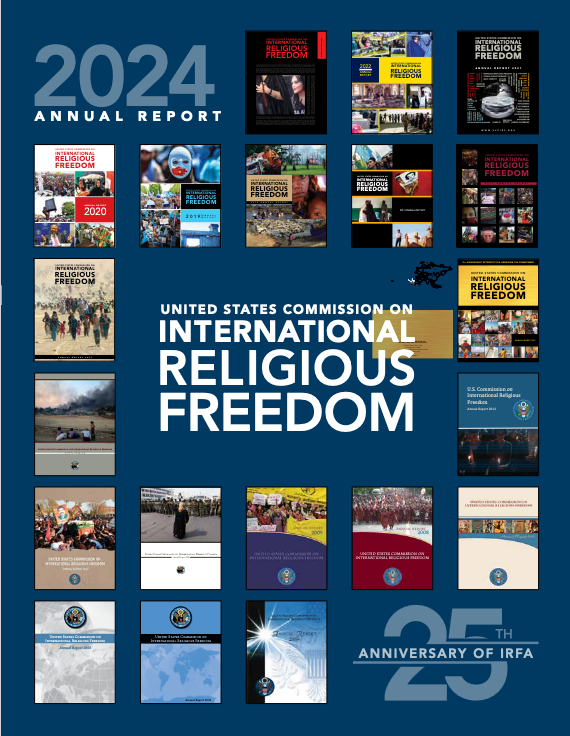
USCIRF Releases 25th Annual Report on International Religious Freedom

Apr. 26, 2024
A Call to End Anti-Semitism on America’s College Campuses

Apr. 26, 2024
The Horrendous and Maddening Anti-Semitism in New York City

Apr. 26, 2024
Religion, the ‘Russian World,’ and the War Against Ukraine

Apr. 25, 2024
Religious Freedom Is Back on the UK’s Agenda
CORNERSTONE FORUM

May. 05, 2023
Public Bioethics & the Failure of Expressive Individualism

Apr. 28, 2023
Religious Liberty in American Higher Education

Mar. 03, 2023
Scotland’s Kate Forbes and the March of Secularism

Dec. 09, 2022
70 Years of Religious Freedom in Sweden: Prospects and Challenges

Nov. 23, 2022